# Gmail Articles
Overview
**Gmail** is Google's email service. **Gmail** is managed via Google's commercial email servers and can be checked in real-time on the web. Access to **Gmail** is available to current faculty, staff, students. **Gmail** smart features include:
- Integration of Google Chat, Meet, Calendar, and other Google Workspace products
- The ability to create and manage spaces for ongoing and long-term conversations
- Utilization of writing and intelligent search suggestions
Access
To access **Gmail** on the web, navigate to gmail.google.com
Note: If you are logged into a personal **Google** account in the same browser, you may be redirected to the inbox for that account. See this [Help Document](https://support.google.com/accounts/answer/1721977?co=GENIE.Platform%3DDesktop&hl=en) to add a second account to your browser session.
To access **Gmail** from a mobile device, download the **Gmail** app from the App Store (iOS devices) or the Play Store (Android devices).
Note: App State recommends using the official Google **Gmail** app rather than third-party mail apps such as Apple Mail.
Help
For tailored assistance with Gmail, contact the Help Desk at helpdesk@cornerstonephiladelphia.com.
For general assistance, visit Google's [Gmail Support Page](https://support.google.com/mail#topic=).
# E-Mail Attachment Limits
## Attachment Size Limit
You can send messages up to 25 MB in size. You may not be able to send attachments larger than 25 MB to contacts who use other email services that have smaller attachment limits. If you'd like to send attachments that are larger than this, you can insert them from GoogleDrive.
**Note: As a security measure to prevent potential viruses, Gmail doesn't allow you to send or receive executable files (such as files ending in .exe).**
## Sending Attachments Larger than 25MB using Google Drive
Gmail's attachment limit is 25MB, but you can insert files larger than 25MB using Google Drive:
1. At the bottom of the email you're writing, click the Google Drive icon  to insert files from Drive.
2. In the “Insert files using Google Drive” menu, you can upload a file to Google Drive from your device or navigate to a file you've stored in Drive. To send a file already stored in your drive, click on the file you want to attach.
3. Choose the option to insert as either a Drive link (a link to your original file) or as an attachment (a copy of your file)
4. Click insert to “insert”.
You can also do this on the Android Gmail app by selecting Insert from Drive from the 3-dots menu. Gmail then adds a link to your message so recipients can click the link to view your file.
## Other Attachment Size Limits
**Messages sent using Google Groups (replaced listserv system):**
To view Google Groups policies and limits, see this help document: [Understanding Groups policies and limits](https://support.google.com/a/answer/6099642?hl=en#zippy=%2Cmessage-and-posting-limits)
# How to Obtain Headers from Email
Below are step-by-step instructions for displaying email header information within several email apps.
## Gmail
1. In Gmail, click on the email you would like to view headers for.
2. Click the three-dot three-dot icon icon next to the **Reply** button.
3. Select **Show Original**.
Show Original
## Mac Mail
1. Open the email.
2. Click on the **View** menu on the Menu Bar.
3. Select **Message**, then **Long Headers**.
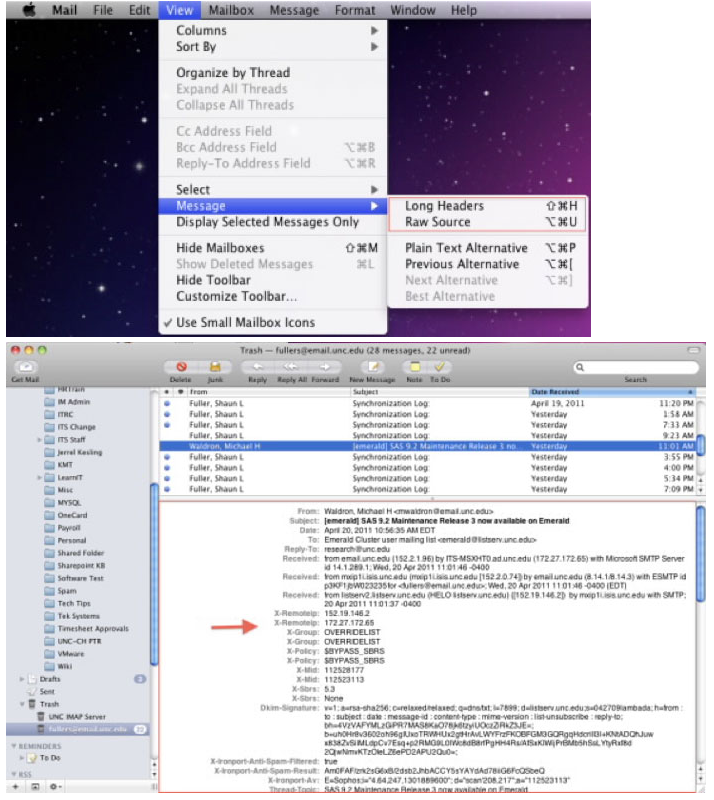Selecting Long Heading from the Message drop-down in the View menu.
## Outlook 2011
1. Right-click on the email that you would like to view the headers for (or use Shift +Click)
2. Click **View Source**.
3. This will open a text file with the Header Information outlook source code.
## Outlook 2010
1. Open the email.
2. Click the **File** Tab.
3. Select **Properties**.
4. The information will be listed under the **Internet Headers** section out look properties.
## Outlook 2007
1. Right-click the email (or use Shift + Click).
2. Choose **Message** from the menu.
3. The information will be listed under the **Internet Headers** Section outlook message options.
## Thunderbird
1. Select the email.
2. Click on **View**.
3. Click on **Headers**.
4. Click on **All**.
5. Click the “Forward” button and all header information will appear at the top of the email.
# I am being redirected when I try to log into my CAA Gmail account
If Google redirects you to your CCA log-in or inbox when you try to log into your personal account OR if Google redirects you to your personal account when you try to log in to your CCA account your browser history is causing this issue. Clearing the history will fix the issue but this solution is temporary because the browser history will save the page/site and cause the same problem in the future.
Internet history, also known as **browser history,** is a tool or resource in a **Web** browser that keeps track of sites and pages that a user visits. Through tabulating URLs, **Internet history** facilitates a quick reference or lookup of previously visited pages.
The best solution to this problem is to add a second account:
1. Log into your CCA account (Log out of your personal account first if you are logged into it.)
2. Click the **Google Apps** icon in the upper right-hand corner.
3. Click **Add another accoun**t.
4. Log in with the email address and password of your personal account.
To switch back and forth between these two accounts, click on the **Google Apps** icon in the upper right-hand corner and choose the account you want to view from the list.
# Sending Mail from a Different Address in Gmail
This guide will show you how to set up the ability to send mail from a different address in your Gmail account.
When sending mail from an alternate email address (e.g., google@cornerstonephiladelphia.com), the sent mail only appears in the sending account and NOT in the alternate email account. For example, if user@cornerstonephiladelphia.com can send mail as google@cornerstonephiladelphia.com, the sent mail only appears in user@cornerstonephiladelphia.com and not google@cornerstonephiladelphia.com.
For more information, navigate to the [Google Support Send emails from a different address or alias](https://support.google.com/mail/answer/22370?hl=en) page.
## How to Grant Someone "Send As" Access
You can send mail from an alternate account when you are within your account by setting up the **Send Mail As** feature:
1. Sign in to your Gmail account.
2. Click the  in the upper-right and select Settings and the Accounts and Import tab.
3. Under "Send mail as", click Add another email address you own.
4. In the Email address field, enter the name and alternate email address of the account you want to send from. Do not select “treat as an alias”.
5. Click Next Step >> and then click Send Verification. Gmail will send a verification message to the other email address to confirm that you should be able to send mail to it.
6. Locate the message from Gmail. Open it and either click the link contained in the message or enter the confirmation code in the Accounts section of your Google Apps email settings.
**Note**: You can also set up delegated access to an alternate account by following the guide here: [Setting up Mail Delegation in Gmail](https://confluence.appstate.edu/x/NgK5).
## How to Revoke "Send As" Access
**IMPORTANT**: if you want the ability to revoke "send as" access, you will need to keep the verification message. There are 2 ways to revoke or terminate the ability to send as another account:
1. From the account that uses the **Send Mail As** feature: Go to Gmail Settings, select the Accounts and Import tab, then click on the delete link next to the account in the **Send Mail As** section.
2. From the account that granted access to the other account: Go to the email that confirmed **Send Mail As** and scroll to the bottom to cancel the verification.